The System
Thirteen principles of Thelema, drawn from the commentary of Frater L.R.H. and stated whole. The commentary proves them verse by verse; this page holds them in one hand. Nothing here is original, and that is its authority: the Book teaches it, the commentary demonstrates it, the System states it.
▸ View the chart: Thelema at a glance
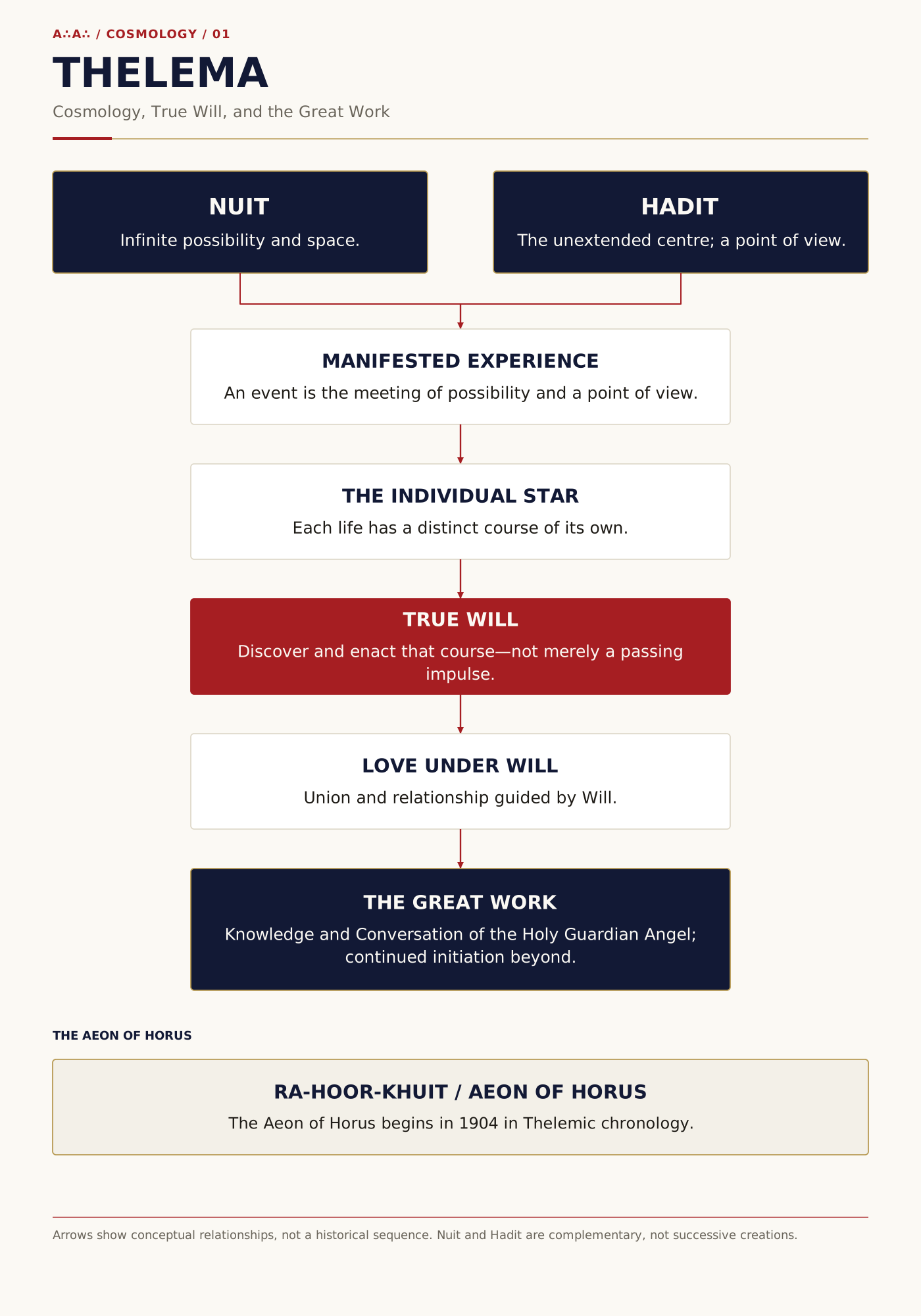
- The Law is Do what thou wilt. Not license but the hardest discipline there is: find the one will at your root and do it, against every pressure to be something more convenient. I:40 I:42–44 III:60
- Every man and every woman is a star. Each life has its own orbit and its own light; no star is judged by the orbit of another. This is the metaphysical charter of an aristocracy open to all. I:3
- The world is two infinites in love. Nuit, infinite possibility, the circumference nowhere found; Hadit, the point of view, every center. Their meeting is every event that ever occurs. I:1 II:2–3
- Existence is pure joy. Sorrow is real and it is an error, the friction of a will off its line, and error can be fought. The religions of sorrow built on the opposite premise, and fell. II:9 I:30
- An Aeon turned in 1904. The formula of the Dying God expired; the Crowned and Conquering Child took the seat in the East, and the equinox of the gods dates every rite and every politics that follows. I:49 III:34
- The Book is the sole scripture, to the letter. Not one letter may be changed; the holograph is reproduced because the Book commands it; the comment is left to the appointed hand and to no other. I:36 I:54 III:47
- The Work is the Knowledge and Conversation of the Holy Guardian Angel. One Angel, one aspirant, attained by graded method and proved in the written record; all else in the system serves this. I:7 II:61–64
- Magick and mysticism are one science. Ritual, mantra, posture, breath, and record: the methods are tested like any other instrument, and joy and beauty are the evidence of right performance. I:37 II:35–36
- The war is first against weakness. Sorrow, pity, and the sanctification of decay are the enemy’s colors; the first territory retaken is your own borders. II:17–21 III:18
- Kingship is of essence. No revolution makes kings of slaves and no catastrophe unkings a King; the one legible mark of rank is a will known and done. II:58 II:24–25
- Death is dissolved in continuity. The King dips in the pool and remains; the feast for death is greater than the feast for life, because the fear of death was the tyrant’s chief weapon. II:21 II:41 II:66
- The Abyss is crossed by renouncing the why. Reason is a fine servant and a fatal ferryman; what crosses is will with nothing in its hands, and what is born there is mightier than all the kings of the earth. II:27–33 III:45
- The Order keeps the record. Teaching owed freely, admission guarded fiercely, advancement by examined attainment, and the descent of authority documented in instruments and imprimaturs, not in assertions. I:38 the record